Interview by Mira Marincaș, June 2025
Studio, Portfolio, Artist talk
Instagram: https://www.instagram.com/pszk.robi/
Facebook: https://www.facebook.com/robert.paszka
Pászka Róbert (b. 2002) is a cinematographer, director, photographer, visual artist, based in Cluj-Napoca, Romania. I studied at the Department of Cinematography, Photography and Media of Sapientia University. Currently preparing for my PHd. and a lot of art in the making.
M.M.: So we start from scratch. What is the key to your thoughts? What are you preparing for Nophto Magazine since you were selected for their mentoring programme?
P.R.: I’m working on an exhibition, containing some of my past works as well as new ones. I take a meditative approach with these photos, I tend to think of the self portraits, as me trying to feel out my body, to know myself a little better. My concept in the beginning started with tripticons, but now that we are in the early stages of the selection process, I tend to pick photographs and even videos that are not part of any tripticons. I’m also working on some new images, as well as video installations for it, so there is a lot of work to be done. I work consistently in black and white, but I do have a very colorful photo of myself drenched in flowers. It is in high contrast with my usual dry and empty aesthetic and it does stick out of the exhibition material.
These self-portraits were included in the curatorial concept of Blank portraits exhibition, at Studio 19 Gallery.
M.M.: Do you work based on emotions, or do you envision artistic concepts and statements while working on the topic of self-portraiture?
P.R.: One of my closest friends told me something that upset me. She said that none of the photos really look or feel like me. I do have to agree with her a bit, I do not believe that any of my self-portraits portray my essence really. That was upsetting, because starting out, I thought of art as something that had the power to compress a lot of information into itself, and I kinda made it my mission at first to weave everything I am into one compressed .jpeg file. Now I realise that I have to try to live with the thought of not being able to capture myself entirely in a two dimensional flat piece of artwork, that’s why I started taking multiple photos, I started changing the perspective I capture myself from, focusing on different characters that represent smaller pieces of my personality.
I have that one blurry photo, where branches come out of my head, reaching towards the sky, or I guess to the top of the photo. It is trying to be the most symbolic out of all of them, because at the time I made it, I did not intend it to be exhibited. I made it for an ex, but I never ended up giving it to her. I was tortured by the looping nature of everyday life, and how this rhythm of life, of not daring to make a change, each day, is very similar to how generational trauma works. I imagined this photograph being able to be stacked on top of itself so it's like a loop, a living image, moving and reshaping, and I tried to hide an element of time in it. The shape of an hourglass, where the grains are only stuck at the neck, for a brief amount of time, and then they move on to the next segment.
M.M.: Analog photography // digital photography, is it still an issue since AI?
P.R.: I used to only work with digital photography, obviously, since I grew up in a time where analog photography was really out of fashion. My parents always joked around that I couldn’t name any unused analog equipment lying around the house, a couple of years ago. During university I discovered analog photography and started experimenting with it, but I made the mistake of approaching it like I did digital photography. That way working with film seemed illogical, a more expensive version of photography that limits me with its grain, fixed iso and white balance. It took some time for me to learn to see the beauty in it and really exploit the unique nature of different film stocks. Now I look at it completely differently than I do at digital photography. There is a warmth to it that I miss in the sensor's raw image formats. The sharper, more perfect the image, the colder I see it. That is why I started layering my digital photographs with analog textures I took from underexposed 35mm frames.
M.M.: Do you see the roles of your character played out by models or is it always about changing your own self, to match the characters. I noticed that some of your photos have a different subject than yourself. Are they still self portraits? Are they self referential images in your vision?
P.R.: These photos were a lot of fun to shoot; they are of my dear friend, shot with a faulty medium format camera, on a film stock that has been expired for about 25 years. We happened to have a great house at our disposal, to work with and some time at our hands, so we started taking photos. I have not used a medium format camera before, so this was a completely new playground for me. After developing the roll, I realised that I severely underexposed the images; most of them weren’t even visible by the naked eye. I managed to save 3 of them, but they had a lot of grain, accidental light leaks, with very little real information. I was so disappointed in them back then that I didn’t even look at them for about 2 years, when my hard drives broke, and I had to send them to a repair shop. When I got the drives back, I wanted to see what survived, and that’s when I stumbled upon them again, this time being able to appreciate them for their flaws. The time I had away from these pictures, almost losing them, made me appreciate them so much more, that now I think they are some of the best photographs I’ve ever taken. I got to see that the accidents and flaws that they have, create new compositions that my brain would never be able to think of, and I could never replicate them.
Now I see that the little information that is left in them, are all I need to tell the story I wanted to in the first place.
M.M.: Why is self portraiture so important to you?
P.R.: Apart from being a great tool for self expression, I think taking self portraits comes easy for me. I mean it is always a difficult job to try to uncover something so deep, but self portraiture has the unique quality of removing anything that is not viscerally connected to myself from the process. In a way I get to be locked into a prison, only having to do work within myself, not having to drain myself with unfamiliar equipment, people or places. I get to do it at my own pace, without dreading the thought of wasting someone’s time. My experience is that making art can seldom feel like a waste of time, and I can only be at peace with that thought when I’m alone. It’s a very calm process. I miss this feeling in filmmaking. When I’m creating in the medium of film, I’m constantly surrounded by very powerful people, whom I love, but the only time I can really take my time and experiment without thinking of the ticking of the clock, is during post processing, when I’m color grading, editing, etc.
M.M.: How do you define texture? Is it something we can touch? Is it something that emotionally overwhelms us? Can texture be art by itself?
P.R.: I use texture to hide information; I love texture, love experimenting with it. I like to emphasize grain and imperfections visually, as well as with audio. While the subject I’m taking a photo of contains information, the grain and texture I combine it with defines it and places it within an emotional world, giving it the weight I want the art piece to have.
M.M.: Can you create a similar texture between several photographs?
P.R.: Of course. Once I have figured out what kind of textures the visual world of a series requires, the next step is to create unity between these textures. I usually try to use a similar visual language between images in the same series when I take the pictures, but in post-production I can connect them even more with texture. I think image noise is a tool in photography like atmospheric sound is in film. You don't notice it, but it creates unity on a subconscious level.
M.M.: How does the light connect to you? As a DOP or as a photographer?
PR.: I have had a strong fascination with light ever since I started my work as a DoP and especially a gaffer. I have made a lot of films where I was really trying to find a narrative reason to use light. I was experimenting with a human figure emitting light, and what it can mean inside the narrative structure of a film. Now I realise that my obsession with a glowing human figure has better outlets than film, but I haven’t yet figured out what it is yet.
I had this concept with one of the films I worked on that I'm gonna present the light like a passing by space, having a nice little evening stroll… all the lights in the night may be called Fields. How does the light connect to me? It feels like it's a space for loneliness to manifest, in a good way, kinda. I think the negative connotation of loneliness exists in daytime only. When it comes to nighttime loneliness, it can become this space to feel your emotions better and to meditate with them a little. In my time as a student I found it peaceful not to have the Sun above me all the time.
M.M.: Did you work on another type or style of photography? What was the preparatory routine until you reached this destination of visual arts?
P.R.: The first few years of taking photos, I didn’t really have a clear vision of what exactly I wanted to portray. To be honest I didn’t really have the slightest idea of what I was doing, I tried everything from street photography, portraiture, fashion and something that past me would call conceptual photography. The birth of my visual style can be very clearly linked to a few hours I spent one night outside, when I was around 20. My train arrived long after city buses stopped running, and taxi prices were way too big for a uni student like myself. So I decided to cross the city on foot. It was a very foggy night. I started taking photos of mundane things. Empty streets, traffic lights, lonely pedestrians. I didn’t think much of it until I looked at the photos. I had to crank the iso up to max, so there was quite a bit of grain on them. But I liked what I saw in a way. I started pushing the blacks up, so the digital grain would show a bit more. The foggy weather helped a lot, it created otherworldly gradients that would have been impossible for me to look for. They were spontaneous in a way. Those images weren’t good by any means, but they did point me in a direction in photography. I started experimenting more consciously with grain.
M.M.: Tell me more about your series called Cranial Nerves.
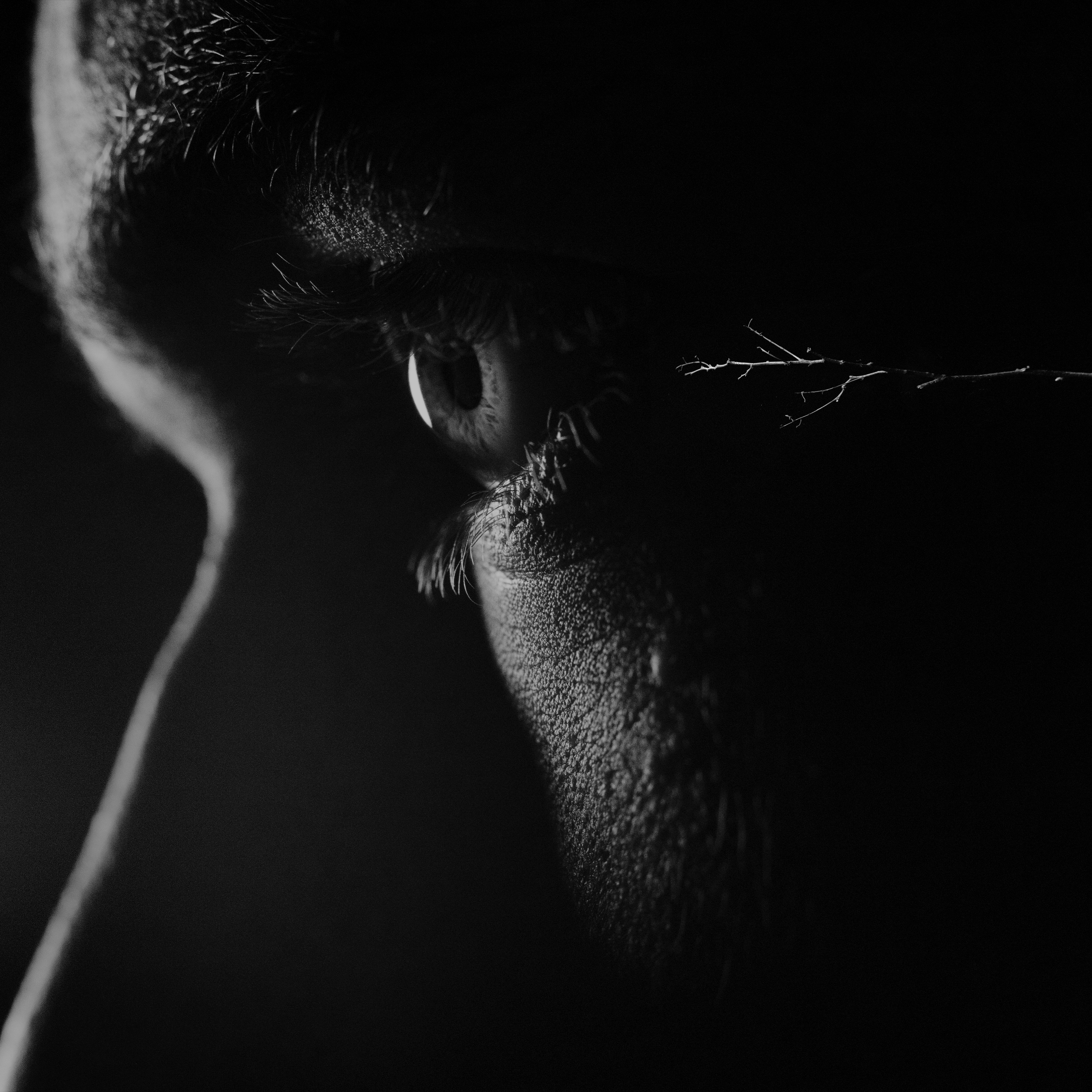
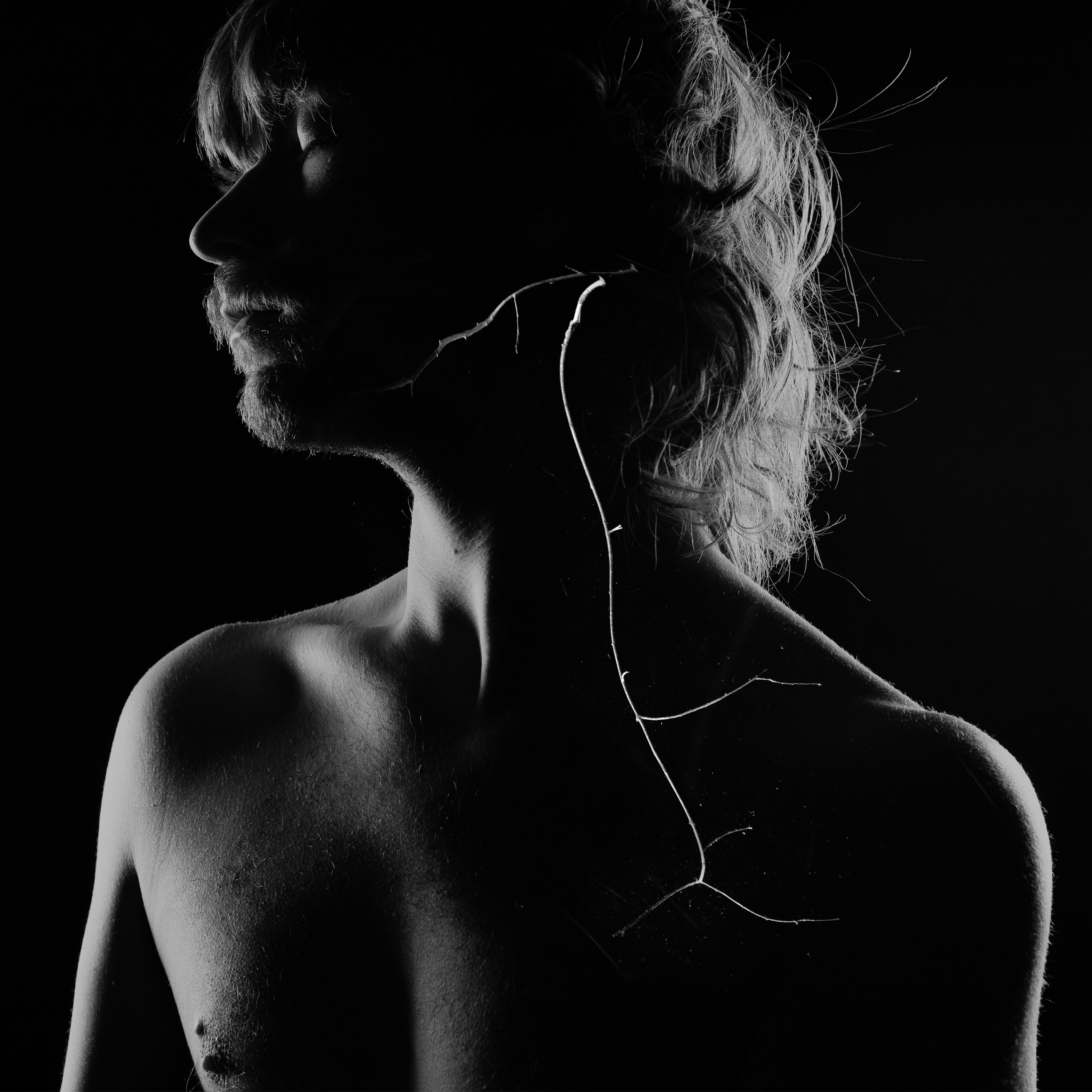
P.R.: This photo series was my most significant technical challenge and the one I worked on the longest. My initial inspiration, during my first year of my bachelor's degree, was a fascination with the cranial nerves, which I approached as "The Thing", making photos of them. Three years ago, I had numerous concepts for this project. I considered making it colorful, perhaps using red for the nerves and blue light on my skin, or even drawing nerves onto 35mm film frames. At that time, I was newly engaging with analog photography and weighing its merits against digital. I contemplated many ideas but executed none.
The next step was to finally commit and do the thing! I initially booked the studio for two consecutive days, aiming to capture all 12 images (representing the 12 cranial nerves). However, I only managed to finish about seven. I had to secure the studio for another two days and ultimately completed the series in a total of four days. That concludes the details about the creation of this specific artwork. I eventually revisited and resumed work on the piece after allowing it a period of rest.
M.M.: There is always more to it than that. What about the overlaps, layerings, did you work with double or multiple exposures?
P.R.: These also work as practicums. Multiple exposures is accurate. The placements here, composition overlaps, layering, resembles one of those things that the biology teachers use in tests, like an illustration of a brain to study.
That's the kind of visuals I was going for.
Somebody told me that the Roman numerals I used in the corners of the photos look like tarot card numerals. I'm still deciding on the final portrayal of cranial nerves and still have to do texture work on them because this version is too sterile for my liking. Too flat.
Now all has to have included installations, even if your work medium is not installation. These are branches, in the images, and also real life bonsai, because I thought that they would look good with the rest of the exhibition.
Ties into the connection with nature and humans and the whole thing about it, cranial nervous system and branching nature's connections.
M.M.: How do you intend to give texture to the final prints of your Cranial Nerves series?
P.R.: I'm going to print it out by hand printing, experimenting with different techniques. I have planned that I'm gonna bring them out in a cyanotype version, that’s just different I think.
Now I am just waiting for you to finish writing what you are writing, recording what you are recording, in order to ask you how I can get rid of the blue after I make the print.
Miiiraaa how can I get rid of the blue after? I need my black you know, I think you get me with this preference.
This photography project requires black and white tones, in my mind. I think they will have to have texture, an analog feel to it, what do you suggest as a different technique?